On-Prem vs Private Cloud for Regulated AI Workloads
A decision framework for choosing between on-prem and private cloud for sensitive AI workloads, with real cost drivers, trade-offs, and when each option fails.
The choice that matters for your first governed LLM is not private versus public; it is where inside your own perimeter the stack sits, and what that costs to stand up and defend.
Picking on-prem for a workload a VPC would have governed just as well buys you three to six months of procurement and two to five extra FTEs you did not need to hire.
On-prem means hardware you own in a facility you control, usually air-gapped or tightly segmented. Private cloud here means a single-tenant VPC or dedicated-hardware tenant inside a hyperscaler or specialized GPU cloud, with your identity, key management, and network controls in front of it.
Both can satisfy a regulator. They differ sharply on GPU economics, audit scope, latency, staffing, and how long before the first prompt runs.
GPU Economics Bend the Decision Before Policy Does
A single 8xH100 server lands around a quarter of a million dollars before you have provisioned a square foot of floor space, and a fully air-gapped pattern runs $200K to $500K per year in infrastructure with three to five dedicated FTEs. A VPC-isolated deployment on the same page comes in at $30K to $100K per year with one to two FTEs. That difference in annual cost and headcount is the single biggest reason to start a first workload in private cloud and move it only when sustained use justifies the move.
Cloud GPU pricing itself has become a moving target rather than a fixed premium. Blended H100 rental rates fell roughly 64% from about $8 per hour at launch in 2023 to $1.70 by October 2025, then one-year contract pricing rebounded about 40% to $2.35 by March 2026. The practical implication is that an on-prem build you commit to today is amortized against a cloud rate you cannot forecast past the next two quarters.
The crossover point most analyses converge on is roughly 60 to 70 percent sustained GPU use. Below that, a dedicated tenant is cheaper. Above it, owned hardware wins on cost per inference, which is why mature training clusters eventually come in-house even when inference stays elsewhere.
Audit Scope Is Where the Choice Actually Diverges
Every regulator cares about the same artefacts: who invoked which model, against what data, under what policy, and what came out. On-prem gives you physical custody of every log and every weight. Private cloud gives you a shared responsibility boundary you have to document.
For a first workload, the harder question is not which model is more secure but whether your governance layer produces the same signed audit either way. A control plane that classifies prompts, enforces identity-aware retrieval, and signs the audit record should emit identical evidence in either deployment. That is the premise of Data.co Control: the policy engine and audit log sit above the runtime so the deployment model becomes an infrastructure question rather than a compliance one. The adjacent argument we have made before, that access control cannot live in the prompt, applies the same way whether the model runs on your floor or in a dedicated tenant.
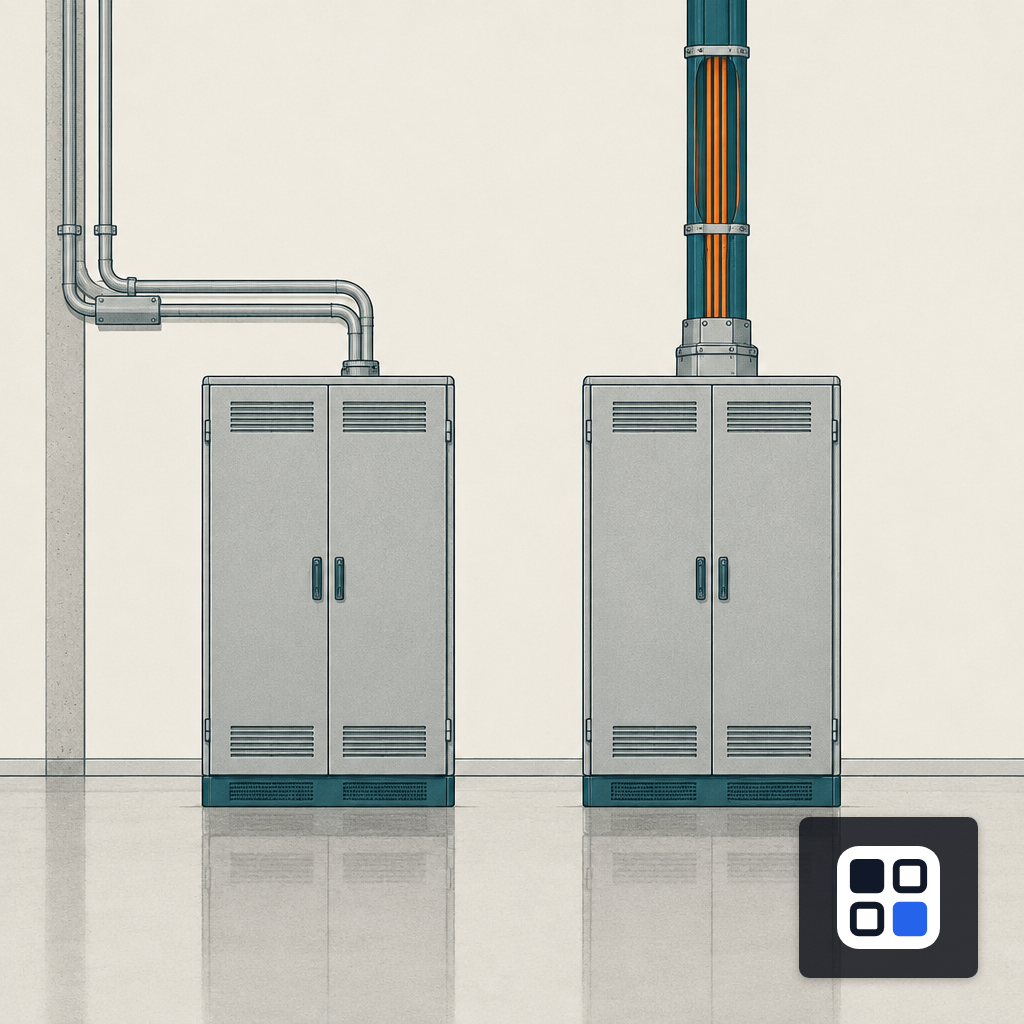
Private cloud does carry a residual audit question on-prem does not: the hypervisor, the control-plane APIs, and the provider's own operators. For most banks and hospitals that is closed by a well-written DPA and the provider's attestations. For classified workloads or anything where HHS cloud-computing guidance does not fully cover the processing path, the residual risk is why air-gap exists.
Latency Is a Real Constraint, but Only for a Small Set of Workloads
On-prem inference typically sits in the 10 to 50 millisecond range depending on network and compute, and edge deployment can push that below one millisecond at the data source. Cloud round-trips add tens to low hundreds of milliseconds depending on region and provider load.
For a chatbot talking to a human, 150 milliseconds is invisible. For a factory vision system or a trading co-location, it is the entire budget. The useful question is not "is on-prem faster" but "does this workload share a network with the system of record it needs to answer about". If the answer is yes and the data rarely leaves, on-prem wins on both latency and egress. If the workload is a RAG assistant over documents already replicated to object storage, private cloud is indistinguishable in practice.
Staffing and Procurement Timeline Shape What You Can Ship This Quarter
A VPC-isolated workload can be in production in two to four weeks with one to two FTEs operating it. An air-gapped build is three to six months with three to five FTEs. A multi-region on-prem footprint is four to six months and four to six FTEs. Those are not negotiating positions; they are the floor for an organization that already has GPU operators on staff. If you do not, add a hiring cycle on top.
Procurement is the other hidden tax. Hyperscaler and specialized-cloud tenants are booked against existing master agreements. On-prem hardware at H100 or B200 scale still involves allocation conversations with NVIDIA partners, facility power upgrades, and in many cases a colocation contract because corporate data centers were not designed for 40-plus kilowatt racks. The honest planning number is six months from signed PO to first governed prompt, and nine is more common.
A Workable Default for the First Workload
For most regulated enterprises standing up their first governed LLM, the defensible default is private cloud on dedicated hardware with a control plane you own, then on-prem for the workloads that earn their way in. Those workloads are the ones with sustained use above the break-even line, a latency budget cloud cannot meet, or a regulatory mandate that excludes shared infrastructure entirely. Everything else lives in the VPC, where procurement is faster, staffing is lighter, and the audit story is already written.
Two questions decide it quickly. First, will this workload run hot enough, long enough, to beat the cloud TCO within the amortization window of the hardware. Second, is there a specific control, residency clause, or latency floor that a dedicated tenant genuinely cannot meet. If both answers are no, build it in the VPC and keep the deployment-model options open under the same policy and audit surface.
The staffing math is the one that catches teams out. Governance for a private AI stack is a 24x7 obligation, and a managed offering covers the 24x7 coverage shortfall when hiring does not. The budgeting side of that is covered in our breakdown of what managed data governance services actually cost.
What You Give Up by Starting in Private Cloud
Starting in a VPC means accepting a provider's hypervisor and operator access in your threat model, a GPU price you cannot lock for more than a year or two, and the prospect of migrating the workload later if sustained GPU use or regulation pushes it on-prem. In return you ship the first governed workload a quarter sooner, with a quarter of the FTEs, against a policy and audit surface that will survive the move. For a first workload whose job is to prove the governance model, that is usually the right trade; the workloads that justify owning the silicon will tell you so once they are running.
Samuel Edwards is Chief Marketing Officer and has spent 15+ years in technical SEO, content strategy and operations for organizations ranging from small businesses to Fortune 500 brands, including NASDAQ OMX, eBay and Amnesty International. At Data.co he writes about the operational half of data and AI: how datasets are described, classified and kept current, and the unglamorous failure modes — stale syncs, mislabeled fields, untracked lineage — that quietly cost the most.