What Belongs in an Enterprise AI Gateway Before It Reaches Production
A reference checklist for building an enterprise AI gateway covering SSO, model routing, DLP, and signed audit logging requirements for regulated workloads.
Letting application servers call model APIs directly, with no gateway in the path, is how an AI incident becomes an AI governance failure. It is also how a security team ends up unable to answer a basic question from auditors: who sent which prompt, against which model, carrying what data.
An enterprise AI gateway is the single process in front of every model call that can enforce identity, route traffic, redact sensitive data, and sign the record. Four requirement sets below define what that process has to do before it reaches production: SSO-propagated identity with permission-aware retrieval, cost-and-sensitivity-aware model routing, DLP at the prompt boundary, and signed audit logging aligned with Article 12.
Each set is independently testable, and each applies whether the gateway sits in front of a hosted frontier model or an on-prem vLLM endpoint.
Identity Must Travel With Every Prompt
The gateway's first job is to refuse any call that cannot be tied to a named human or a named service account. Terminate OIDC or SAML at the gateway itself, and bind that assertion to every downstream retrieval call, every tool invocation, and every model request. Static API keys shared across a team break the audit requirement before it starts: after an incident, the log cannot tell you which engineer actually submitted the prompt, and there is no replay that can reconstruct the user context after the fact.
Permission-aware retrieval is the harder half of identity. When a prompt triggers a RAG lookup, the user's SharePoint, Confluence, or warehouse group memberships should be propagated into the vector store filter before any chunk is scored, not applied as a post-hoc redaction. Teams that skip this step find retrieval returning documents the user cannot open in the source system, which is the failure mode discussed in a prior piece on AI access control. The identity layer should attach the authenticated principal to a policy engine that reflects current group membership rather than a nightly export, so that a de-provisioned user cannot retrieve a chunk minutes after their account is disabled.
Model Routing Decides Cost, Quality, and Data Path
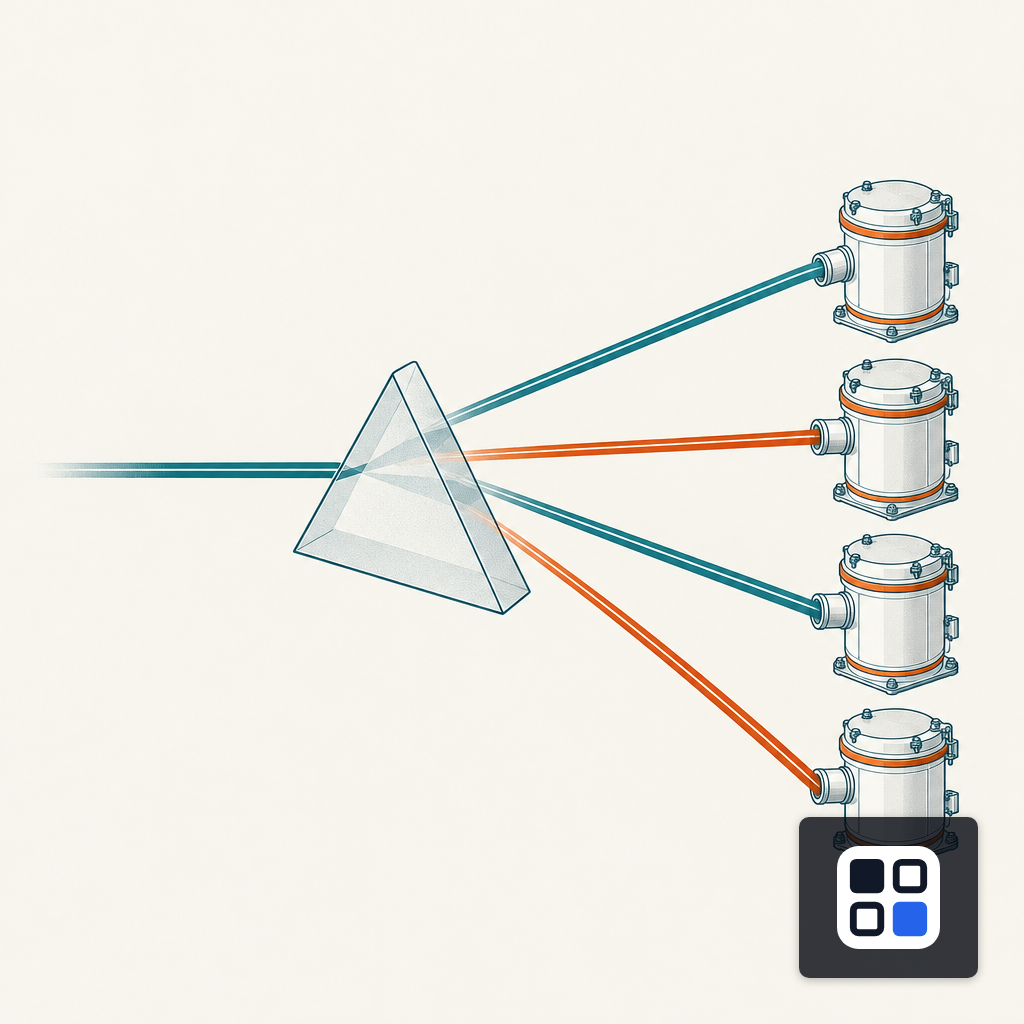
Not every prompt belongs on the same model. The gateway is the one place that can enforce a routing policy against both cost and data sensitivity: a classifier reads the prompt and any attachments, and the policy selects the cheapest model allowed for that classification. The RouteLLM study showed that routing between a stronger and a weaker model on MT Bench can deliver 3.66x cost savings while preserving 95% of GPT-4 response quality, which is the quantified case for building this as a first-class gateway function rather than a client-side flag.
For regulated workloads, the more consequential routing dimension is destination, not cost. Public data can go to a hosted frontier model; data classified as PHI, PII, or privileged must stay on an on-prem or private cloud endpoint. If that decision lives in application code, a single misconfigured client will route the wrong classification to the wrong model, and the audit layer will not catch it until a quarterly review. The trade-offs between those destinations are covered in a deployment comparison, and the routing policy should be able to pin a classification to a specific endpoint, not just a model family.
DLP Belongs at the Prompt Boundary, Not After
Data loss prevention at the AI layer has two directions. Inbound: the prompt itself leaks sensitive data to the model. Outbound: the response returns more than the user was entitled to see. The gateway inspects both. On the way in, a DLP engine matches regex, named-entity recognition, and trained classifiers against the prompt before it leaves the perimeter. On the way out, it redacts fields that the retrieval layer should never have returned, as a second line of defense behind permission-aware filtering.
Prompt injection is the top-ranked risk in the 2025 OWASP Top 10 for LLM Applications because models process trusted instructions and untrusted retrieved data in the same context. An attacker's instructions embedded in a document can override the system prompt, and the gateway cannot eliminate that risk by itself. What it can do is constrain what the model is permitted to do when it is tricked: scope tokens to a specific tool set, block tool calls to high-risk destinations, and refuse responses that match known exfiltration patterns. The classifier output also feeds the audit record, so an incident investigation has the DLP decision and the matched pattern available without a separate SIEM query.
Signed Audit Logs Are the Deliverable Regulators Require
Article 12 of the EU AI Act requires high-risk AI systems to technically allow for the automatic recording of events over the lifetime of the system, with minimum fields including the start and end time of each use for biometric identification. The compliance deadline for standalone high-risk systems under Annex III was deferred to December 2027 under the Digital Omnibus, but the technical record-keeping obligation itself did not change: production systems need the log, and the audit trail has to survive scrutiny at any point in the system's life.
A gateway audit log fit for that obligation records, per request:
- The authenticated subject and the groups used in the retrieval filter.
- The model and version called, and the destination endpoint.
- A hash of the full prompt and a hash of the full response.
- Every retrieved document ID, with the ACL check outcome.
- The DLP decisions applied, including matched patterns.
- A signed timestamp chained to the previous record.
Chaining matters because it makes later deletion or modification detectable. Teams storing logs in a mutable database should assume an auditor will ask for cryptographic evidence that records have not been altered, and that question is easier to answer before the first incident than after it. The compliance frameworks page lists the specific obligations this schema is designed to satisfy.
Where the Four Requirement Sets Converge in Production
The four sets are not independent in practice. A routing decision that strips identity makes the audit log useless. A DLP engine that cannot read the authenticated subject cannot apply role-appropriate redaction. The record-keeping obligation collapses if the gateway cannot trace a response back to the specific documents the retrieval layer returned under the user's permissions. Each boundary depends on the one before it, and the audit log is how an investigator reconstructs the chain.
The pressure to ship without the connections in place is measurable. A recent Gartner survey found that 71% of organizations expect to deploy agentic AI within the next twelve months, while only 21% have agentic AI governance capabilities in place today. That governance shortfall closes faster when a single component handles all four responsibilities on behalf of every application in front of it, which is the position occupied by Data.co Control.
The question worth putting to a gateway vendor, or to the team building one internally, is narrow: when a user with no access to a particular document submits a prompt that happens to match it, what happens at each of the four layers? A good answer names the retrieval filter rejecting the chunk on the user's groups, the DLP layer redacting any fragment that slipped through, the routing layer sending only sanitized text to an allowed model, and the audit log recording all of it with a signature that can be verified later. An answer that collapses two of those layers into application code is unlikely to survive a regulator review or a post-incident reconstruction.
Samuel Edwards is Chief Marketing Officer and has spent 15+ years in technical SEO, content strategy and operations for organizations ranging from small businesses to Fortune 500 brands, including NASDAQ OMX, eBay and Amnesty International. At Data.co he writes about the operational half of data and AI: how datasets are described, classified and kept current, and the unglamorous failure modes — stale syncs, mislabeled fields, untracked lineage — that quietly cost the most.